Delay-калькулятор
В своей работе звукорежиссёру и композитору приходится вычислять время музыкальной задержки, необходимое для отстройки звуковой обработки, и не только. Онлайн-приложение Delay-калькулятор автоматически вычисляет значение времени задержки (длительность звучания ноты) в миллисекундах для целых нот, нот с точкой и триолей, задав значение темпа в BPM (Beats Per Minute – удары в минуту). Малые значения задержки могут быть использованы для создания стереоэффекта.
1 секунда = 1000 миллисекунд (ms).
Как рассчитать дилей в темп
Здравствуйте, с математикой плохо, подскажите пожалуйста формулу расчета времени дилэя в зависимости от темпа , чтобы повторения попадали в такт( были кратными ему)
Участник форума
Регистрация: 15.08.2006
Сообщений: 4,057
Delay = 60/(BPM*N) ; BPM — темп в ударах на минуту; N=1,2,3,4..- целое число (число повторений в единицу темпа). Delay при этом будет в секундах.
__________________
Как мало нам даёт любовь, её добыча — обладанье, её безумство — оправданье житейской глупости любой.
Бывает зверь свиреп, но и ему знакома жалость, нет жалости во мне — а значит я не зверь.
Я инспектор полиции. Находить — моя профессия. Терять — занятие всех остальных.
Многополосный компрессор. Нет лучшего способа испортить звук.
Участник форума
Регистрация: 08.01.2009
Адрес: Великий Новгород
Сообщений: 2,192
Чегой то не выходит, подобранный на слух отличается от формульного, число повторов учитывается внутри такта или вообще ?
Участник форума
Регистрация: 08.01.2009
Адрес: Великий Новгород
Сообщений: 2,192
Все пошло , спасибо, сначала запутался с числом повтора
Модераторы
Регистрация: 24.10.2001
Сообщений: 14,964
Это зависит от размерности и степени свингованости ритма.
например при ортодоксальном 4/4 ритме в темпе 120/60 bpm подходящие задержки кратны 250 или 125 мс — 250, 375, 500, 625, 750.
однако, если ритмика содержит классические триоли, то задержки могут быть такие: 333, 500, 667, 1000 мс
в более сложных ритмиках (пентоли, септоли. ) или с произвольно свингованостью задержки могут быть еще менее очевидными, но тоже легко вычисляются, если аранжировщик себе ясно представляет ритмику во времени. Надо учиться рисовать ритмы и смотреть на графике куда попадают те или иные «отражения».
__________________
neane.ru — много интересного
| Андрей Климковский |
| Посмотреть профиль |
| Найти ещё сообщения от Андрей Климковский |
Участник форума
Регистрация: 08.01.2009
Адрес: Великий Новгород
Сообщений: 2,192
Я пробую дилэй с простого(в стиле раннего Жара), чтобы при темпе 145 отражения попадали на сильную долю такта , у меня вышло 413,7 миллисекунд при условии одиночных или двойных нот , с триолями пока не получается
Регистрация: 28.07.2007
Адрес: новогиреево
Сообщений: 21
Вот из Овсински выдержка, может, поможет с триолями.
Время задержки измеряется относительно темпа с помощью музыкальных длительностей. Иначе говоря, если темп песни120 уд/мин., то время звучания одной четверти будет полсекунды. (60 с:120 уд./мин. = 0,5 с) Таким образом, задержка в четверть будет равна половине секунды (или 500 мс, по общепринятой градуировке).
Но 500 мс — слишком большой промежуток времени, и может отодвинуть сигнал-источник
относительно музыки слишком далеко назад. Разделите это время пополам, и получите задержку в одну восьмую. (500 мс: 2 = 250 мс).
Разделите еще раз, и получите задержку в одну шестнадцатую. (250 мс: 2 = 125 мс).
Еще раз — получится время задержки в одну тридцатьвторую. (125 мс: 2 = 62,5 мс, округляем до 63).
Снова делим пополам и получаем задержку в одну шестьдесятчетвертую. (62,5 мс: 2 = 31,25 мс, округляем до 31).
Делим еще раз, (31,25 мс: 2 = 15,625 мс, округлим до 16 мс), получаем одну стодвадцатьвосьмую.
Делим пополам и получаем одну двестипятьдесятшестую (16 мс: 2 = 8 мс).
Несмотря на мнимую мизерность задержек в 8 и 16 мс, ими пользуются постоянно — делают
звук больше и шире. Но даже такая короткая задержка значительно естественнее вписывается в звучание, если предварительно рассчитана.
Иногда необходимо использовать другие нотные длительности — триоли, восьмые, шестнадцатые с точкой, и т.д. Они вычисляются по формулам:
Время задержки x 1,5 = Нота с точкой
Пример: 500 мс (задержка в 1 четверть при темпе 120 уд./мин. ) х 1,5 = 750 мс, или четверть
с точкой.
Время задержки х 0,667 = Триольная длительность
Пример: 500 мс (задержка в 1 четверть при темпе 120 уд./мин. ) х 0,667 = 333,5 мс, или
триоль восьмыми.
Так же, как и при квадратном дроблении (четверти, восьмые и т. д.) вы можете постоянно делить приведенные значения пополам, пока не вычислите нужное время задержки.
Расчет времени задержки.
60000 : Темп в уд./мин. = Задержка в одну четверть в миллисекундах.
Все остальные значения рассчитываются:
Деление на 2 = более короткие длительности.
Умножение на 1,5 = длительности с точкой.
Умножение на 0,667 = триольные длительности.
Участник форума
Регистрация: 08.01.2009
Адрес: Великий Новгород
Сообщений: 2,192
Спасибо, эту информацию надо хранить на листочке перед глазами
Работа с BPM Analyzer и Delay Time Calculator
В этом видео мы рассмотрим две программы, которые могут значительно упростить жизнь звукорежиссера — это MixMeister BPM Analyzer и Delay Time Calculator. Первая названная программа позволяет определить темп аудиозаписи, что может быть очень полезно, если вы не знаете оригинальный темп композиции или мультитрека, с которым вам предстоит работать. Delay Time Calculator, в свою очередь, позволяет рассчитать время музыкальных длительностей в миллисекундах, что будет очень кстати при настройке параметров компрессора, дилея или любых других эффектов, основанных на времени. Обязательно возьмите на вооружение программы, показанные в видео, так как они помогут вам сделать вашу работу с музыкальным материалом быстрее и эффективнее.
Delay & Reverb Time Calculator
Alter the BPM and you will directly see fitting reverb settings and also delay lengths for different note values.
Some ways on how to use the delay times are explained below the calculator.
| Reverb Size | Pre-Delay | Decay Time | Total Reverb Time |
|---|---|---|---|
| Hall (2 Bars) | 62.5 ms | 3937.5 ms | 4000 ms |
| Large Room (1 Bar) | 31.25 ms | 1968.75 ms | 2000 ms |
| Small Room (1/2 Note) | 15.63 ms | 984.38 ms | 1000 ms |
| Tight Ambience (1/4 Note) | 3.91 ms | 496.09 ms | 500 ms |
Delay lengths for different note values in reference to your BPM
| Note Value | Notes | Dotted | Triplets |
|---|---|---|---|
| 1/1 (1 Bar) |
2000 ms / 0.5 Hz | 3000 ms / 0.33 Hz | 1333.33 ms / 0.75 Hz |
| 1/2 (2 Beats) |
1000 ms / 1 Hz | 1500 ms / 0.67 Hz | 666.67 ms / 1.5 Hz |
| 1/4 (1 Beat) |
500 ms / 2 Hz | 750 ms / 1.33 Hz | 333.33 ms / 3 Hz |
| 1/8 | 250 ms / 4.00 Hz | 375 ms / 2.67 Hz | 166.67 ms / 6.00 Hz |
| 1/16 | 125 ms / 8.00 Hz | 187.5 ms / 5.33 Hz | 83.33 ms / 12.00 Hz |
| 1/32 | 62.5 ms / 16.00 Hz | 93.75 ms / 10.67 Hz | 41.67 ms / 24.00 Hz |
| 1/64 | 31.25 ms / 32.00 Hz | 46.88 ms / 21.33 Hz | 20.83 ms / 48.01 Hz |
| 1/128 | 15.63 ms / 63.98 Hz | 23.44 ms / 42.66 Hz | 10.42 ms / 95.97 Hz |
| 1/256 | 7.81 ms / 128.04 Hz | 11.72 ms / 85.32 Hz | 5.21 ms / 191.94 Hz |
| 1/512 | 3.91 ms / 255.75 Hz | 5.86 ms / 170.65 Hz | 2.6 ms / 384.62 Hz |
Delay & Reverb Calculator
You can now also calculate your delay and reverb settings within the respective Android app.

Find the right time settings for your reverb!
Many professional audio engineers set their reverb according to the tempo of the song they are working on. The reason for this is to make the reverb vibe with the pulse of the track. With this handy Pre-Delay and Reverb Time Calculator, you can easily find out which pre-delay and decay time settings are likely to go with the BPM of your song. If you want to detect the BPM of a song check out the BPM Calculator.
A natural sounding reverb brings more life to your music
To get a natural sounding reverb the pre-delay is crucial. Humans are accustomed to hearing a specific delay before they hear a reverb. This gap is defined by the pre-delay of your reverb. In the calculator above you can find commonly used values for the pre-delay and the decay time. Adding or subtracting a few milliseconds from these timing values can create a pushing or pulling feel to your groove.
How to calculate the pre-delay of your reverb
If the above settings do not fit your needs you can of course also use different settings. As long as you use values that divide into the total reverb time, you can create a variety of different room sizes and audience distances while sounding groovy and musical at the same time. The total reverb time or reverberation time is the time it takes for the sound pressure level to reduce by 60 dB. It is also referred to as RT60.
To make it easier, here is a small example of how you can calculate the pre-delay of your reverb.
1/64 delay time: 31.25 ms –> pre-delay time: 31.25 ms
1/2 delay time: 1000 ms –> decay time: 1000 ms – 31.25 ms = 968.75 ms
The second table shows you the delay lengths of different note values, which are a good starting point for your pre-delay and decay time. In this example, I took the 1/64 notes delay time as my pre-delay. Should the pre-delay be too long you can also take the 1/128 notes delay time. If it is too short you can also try out the 1/32 delay time.
Next, we want to adjust the decay time to fill the gap between the pre-delay and the total reverb time. I chose the delay length of a half note to create a small room. Now you just have to subtract the pre-delay from the total reverb time to get the decay time. Which in this example is 968.75 ms.
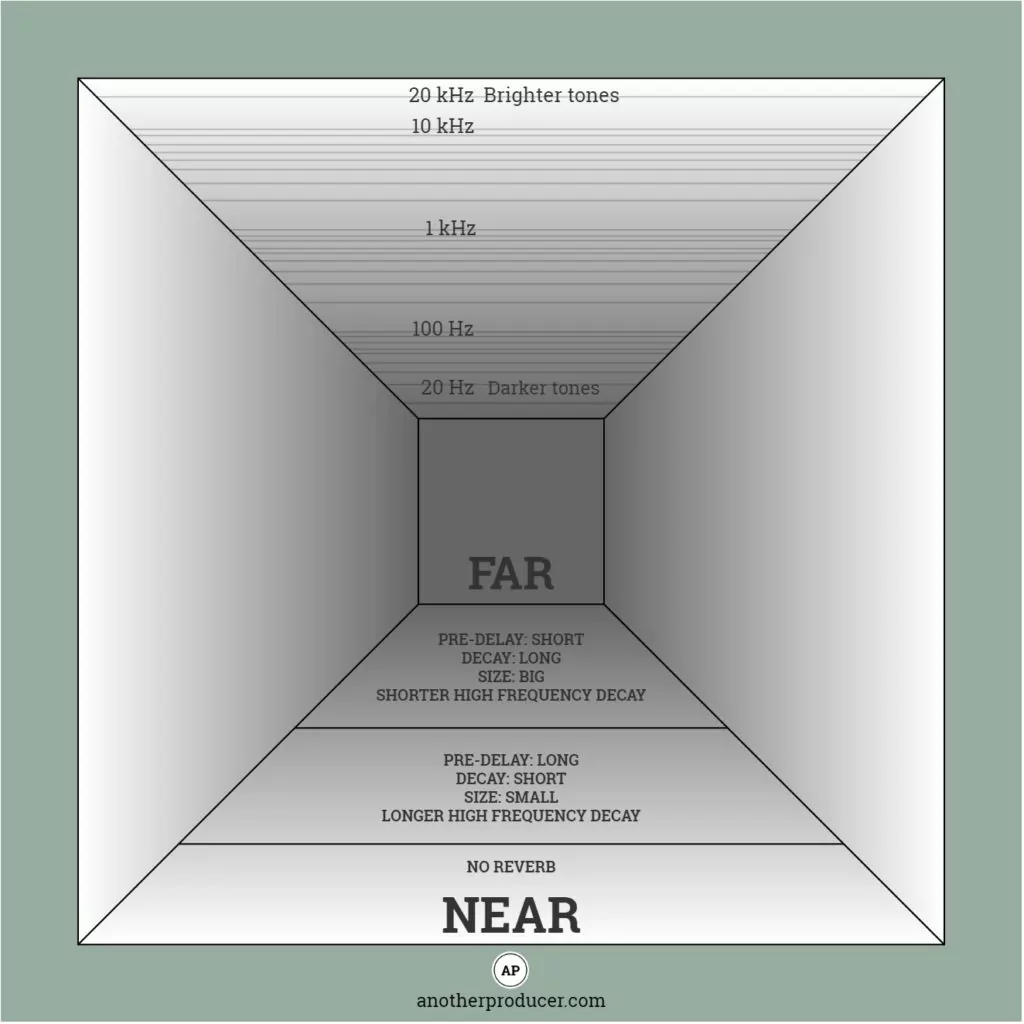
Using multiple reverbs to create depth in your track
You can use different reverb settings for different instruments in your track to create depth. Strings, for example, can sound amazing with a long reverb tail while the kick drum maybe should stay up front (it all depends on what you want to create). But use this technique cautiously, as many reverbs can also destroy your mix. Especially if you only have instruments that would normally play in the same room. If this is the case, you can use the same room reverb on all instruments to create the feeling that all instruments are playing in the same place.
Some additional tips: Often a room reverb for a song is adjusted to the snare. The goal is that the reverb of one snare hit dies just before the next snare hit. While the snare most often comes on upbeats the half note delay is always a good starting point if you are in a 4/4 time signature, and your snare hits on the 2nd, and 4th beat. If your snare hits on the 3rd beat, you can try out the whole notes delay time as a total reverb time. To further clean up your mix try a low- (600Hz) and a high cut (ca600Hz) on your reverb. You can also put a compressor on your reverb send and sidechain it to the audio source so the reverb gets ducked when your instrument plays. You can find more information on how to mix reverb in this blog article by iZotope.
Delay Calculator to determine the right delay time for your song
You can use a delay to make your tracks more interesting by adding movement, and also depth. Timing the delay to the tempo of your track will create depth while the delay is not noticeable. But sometimes you also want the delay to be noticeable. For example, when you want to add movement. The Delay and Reverb Time Calculator can help you with both.
While most modern delay effects can be synchronized to the projects BPM some are not capable of doing this. The delay calculator helps you to find the right settings for your delay. For depth, just try out different delay times out of the normal notes list.
A great way to create movement is by adding multiple delays, with different timings. It even gets more interesting if you use triplets or dotted notes. For example, you can try using three different delays with three different delay lengths and pan them to the right, the center, and the left.
Furthermore, the delay calculator is very useful if you use guitar pedals, that allow you to enter a delay in milliseconds.
Tune your LFO to the tempo of your song
A low-frequency oscillator (LFO) is an electronic device (or software) which creates a rhythmic pulse or sweep that usually is below 20 Hz . This pulse is often used to modulate synthesizers, delay lines and other musical gear to create effects like vibrato, tremolo and phasing for example.
In addition to the milliseconds, the delay calculator also shows you the respective Hertz values for the various note values. Try some of them with your LFOs to create great effects that vibe with your tracks.
